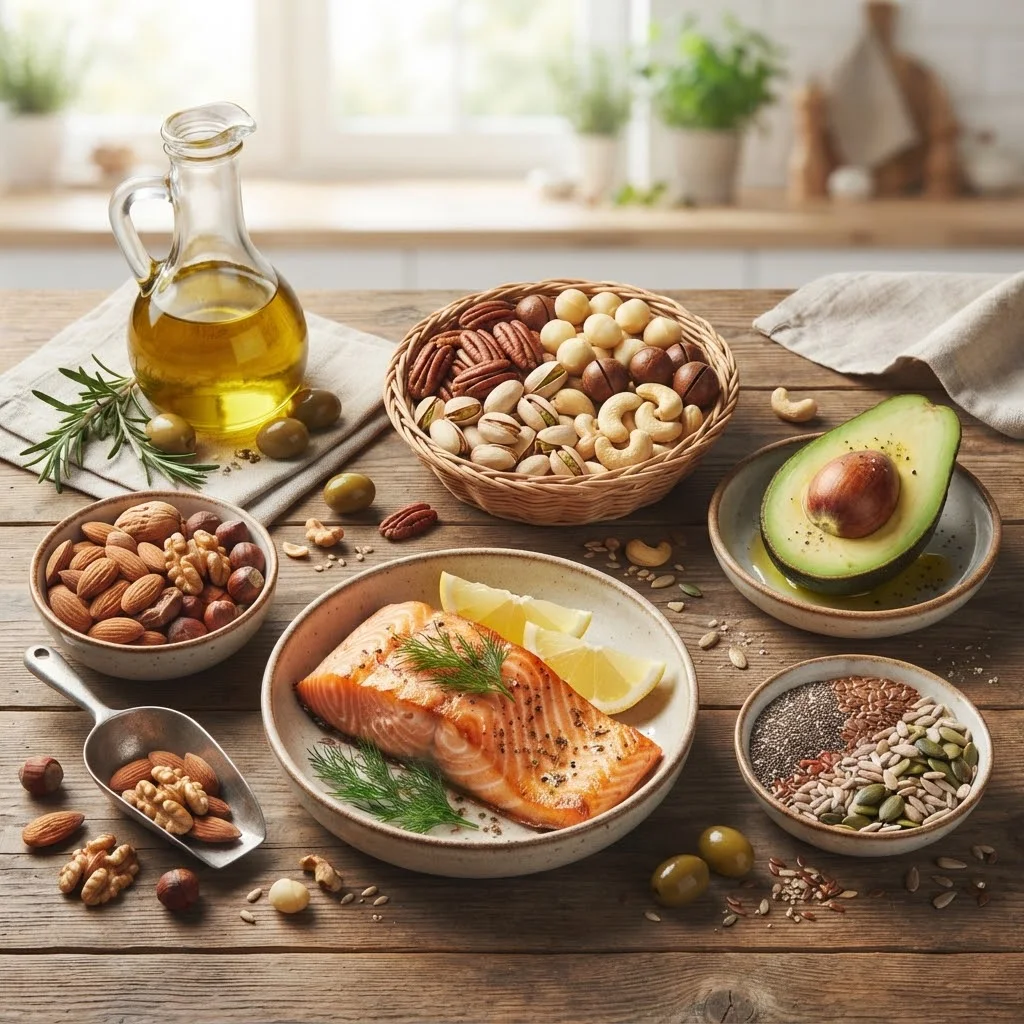
Dietary fat is one of the three main macronutrients and the most energy-dense, providing about 9 kcal per gram. It contributes to cell membranes, essential fatty-acid intake, absorption of vitamins A, D, E, and K, and production of important signaling compounds.
Major types
Unsaturated fats: found in olive oil, nuts, seeds, avocado, and fish; these can form most of dietary fat.
Saturated fats: found in fatty dairy, fatty meat, butter, and some tropical oils; intake should fit a balanced pattern.
Industrial trans fats: should be minimized and may occur in products containing partially hydrogenated oils.
Dietary fat is not body fat
Eating fat does not automatically send that exact fat to storage. Body-fat gain is driven mainly by a sustained energy surplus. However, oils, nuts, and nut butters are calorie-dense and can raise intake quickly.
Fat and exercise
At lower intensities, a greater proportion of energy may come from fat, but this does not guarantee more body-fat loss over time. Fat loss depends on energy balance and adherence. Athletes should not drive fat intake extremely low merely to remove calories.
How much?
General guidance often uses a percentage range, while individual needs depend on calories, goals, and preference. Roughly 20–35% of energy is a common adult reference range. Food quality and essential fatty acids matter more than hitting one exact percentage.
Fat before training
Fat slows gastric emptying. A very high-fat meal close to training can feel heavy. A moderate amount is usually fine several hours beforehand; people prone to digestive discomfort may prefer less near the session.
Practical choices
Measure oils rather than pouring by eye.
Include fish regularly when appropriate.
Use portion awareness with nuts and seeds.
Emphasize unsaturated fats and minimize industrial trans fat.
Do not remove fat entirely to create room for carbohydrates.
Bottom line
Dietary fat is essential but energy-dense. Emphasizing unsaturated sources, sensible portions, and the whole dietary pattern is better than fearing fat or eating unlimited amounts of foods labeled “healthy.”
References
National Academies — Dietary Reference Intakes for Macronutrients — https://www.nationalacademies.org/read/10490
National Academies — Macronutrient DRI Summary — https://www.nationalacademies.org/cdn/materials/9fb9fae1-63a0-4048-88ad-3f972639149a
Dietary Guidelines for Americans — https://www.dietaryguidelines.gov/