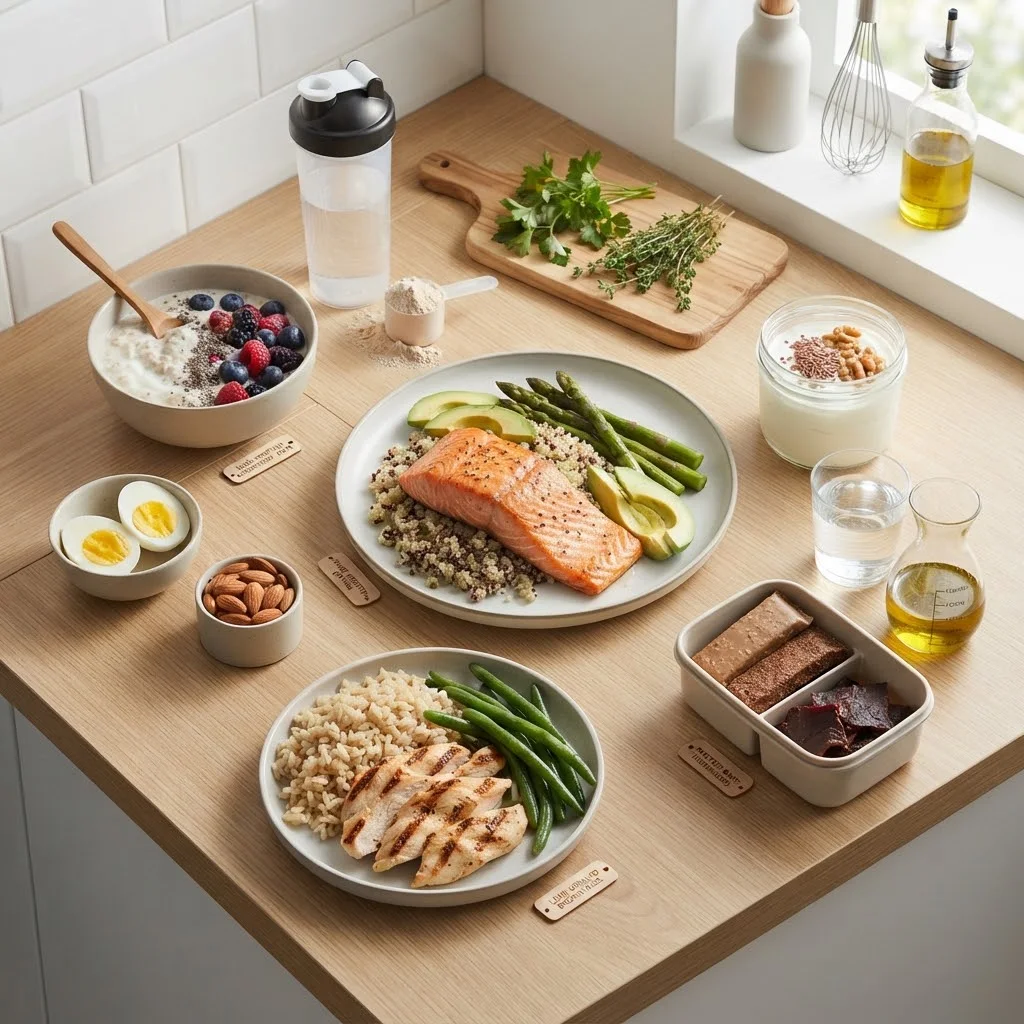
For most healthy people performing resistance training, about 1.4–2.0 grams of protein per kilogram of body weight per day is a practical evidence-based range. The middle or upper part may be useful during muscle gain, calorie restriction, or higher training volumes.
Quick calculation

| Body weight | 1.6 g/kg | 2.0 g/kg |
|---|---|---|
| 60 kg | 96 g | 120 g |
| 75 kg | 120 g | 150 g |
| 90 kg | 144 g | 180 g |
| 100 kg | 160 g | 200 g |
Starting near 1.6 g/kg works well for many. A higher target may make sense during a larger deficit, at very low body fat, or with demanding training. More protein does not automatically create more muscle.
Current weight or target weight?
Current weight is useful for many people. With substantial obesity, it can produce an unnecessarily high number; a realistic target weight or fat-free mass may be more practical. Individual assessment helps here.
Distribute it
Spread protein over three to five meals. A person targeting 140 g could use four meals containing roughly 30–40 g rather than placing 90 g at dinner. Meals need not be identical, but several meaningful protein servings are useful.
Before or after training?
Total daily protein is the first priority. A protein-containing meal within a few hours before or after training is practical. If you ate a substantial pre-workout meal, there is no need to panic about drinking a shake in the first few minutes afterward.
Example for 140 g
Breakfast: eggs and yogurt, about 30 g
Lunch: poultry or legumes plus dairy, about 40 g
Snack: milk or a shake, about 25 g
Dinner: fish, meat, soy, or a plant combination, about 45 g
Values vary with brands, cooked versus raw weight, and portion size; check a reliable label or food database.
When is extra protein unnecessary?
Once needs are covered, replacing large amounts of carbohydrate or fat with still more protein may only make the diet harder and more expensive. Muscle gain also requires progressive training, suitable energy intake, sleep, and time.
Who needs caution?
Kidney disease, some liver conditions, pregnancy, and individualized medical advice require a personal plan. General information cannot replace clinical assessment.
Bottom line
For many lifters, starting around 1.6 g/kg and adjusting within 1.4–2.0 g/kg is sensible. The daily total, distribution, and training quality matter more than supplements or minute-by-minute timing.
References
ISSN Position Stand: Protein and Exercise — https://pubmed.ncbi.nlm.nih.gov/28642676/
National Academies — Dietary Reference Intakes for Macronutrients — https://www.nationalacademies.org/read/10490
ACSM — Ten Things You Need to Know About Sports Nutrition — https://acsm.org/ten-sports-nutrition-facts/