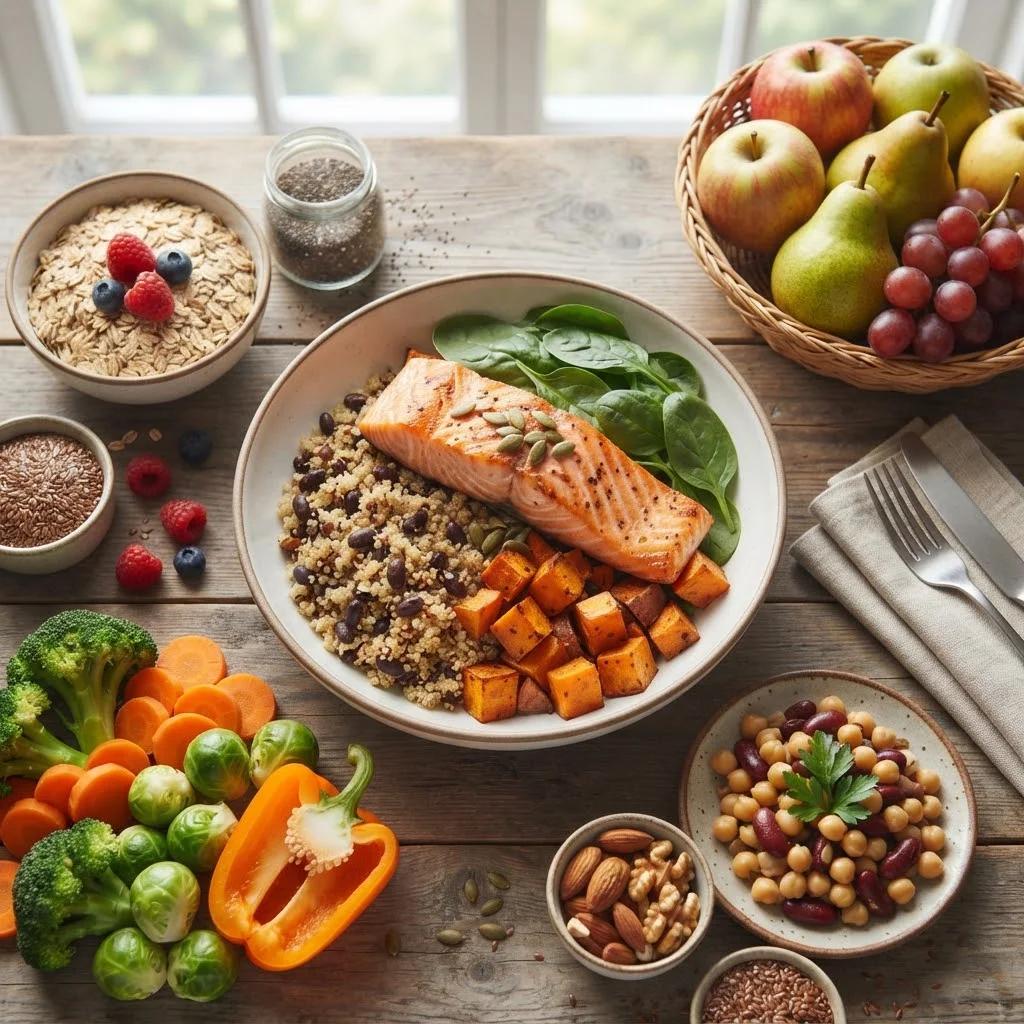
Athletes still need fiber for digestive health and overall diet quality. Yet a very high-fiber meal just before hard training or competition can cause bloating, heaviness, or urgency. The answer is not to eliminate fiber but to distribute it intelligently.
The short answer
WHO recommends at least 25 g of naturally occurring fiber per day for adults. U.S. DRIs list about 38 g for younger men and 25 g for younger women. Personal needs should reflect energy intake, age, sex, and digestive tolerance.
Why one number does not fit everyone
Someone eating 3,500 kcal consumes more food than someone eating 1,800 kcal and may tolerate more fiber. Constipation history, IBS, sport type, and training time also matter. The target should support health without becoming impractical.
How to time fiber around training
In the two to four hours before hard exercise, keep fiber within your known tolerance. If sensitive, place larger servings of legumes, bulky vegetables, and bran after training or farther from the session. Routine workouts usually do not require severe restriction.
A practical way to increase fiber
Start by adding one whole-fruit serving, one vegetable serving, and one portion of legumes or whole grains. Adjust weekly according to bloating, bowel function, and training comfort. Adequate fluid is essential as fiber rises.
Practical tips
Do not double fiber overnight.
Do not test unfamiliar high-fiber foods on competition day.
Seek professional assessment for severe or persistent symptoms.
Bottom line
Numbers are starting points, not verdicts. The right choice must fit goals, calories, training quality, digestion, and real trends. Make small changes and assess them over several weeks.
References
WHO — Carbohydrate Intake for Adults and Children — https://www.who.int/publications/i/item/9789240073593
National Academies — Essential Guide to Nutrient Requirements — https://www.nationalacademies.org/read/11537/page/79
Academy of Nutrition and Dietetics, Dietitians of Canada and ACSM — Nutrition and Athletic Performance — https://pubmed.ncbi.nlm.nih.gov/26920240/