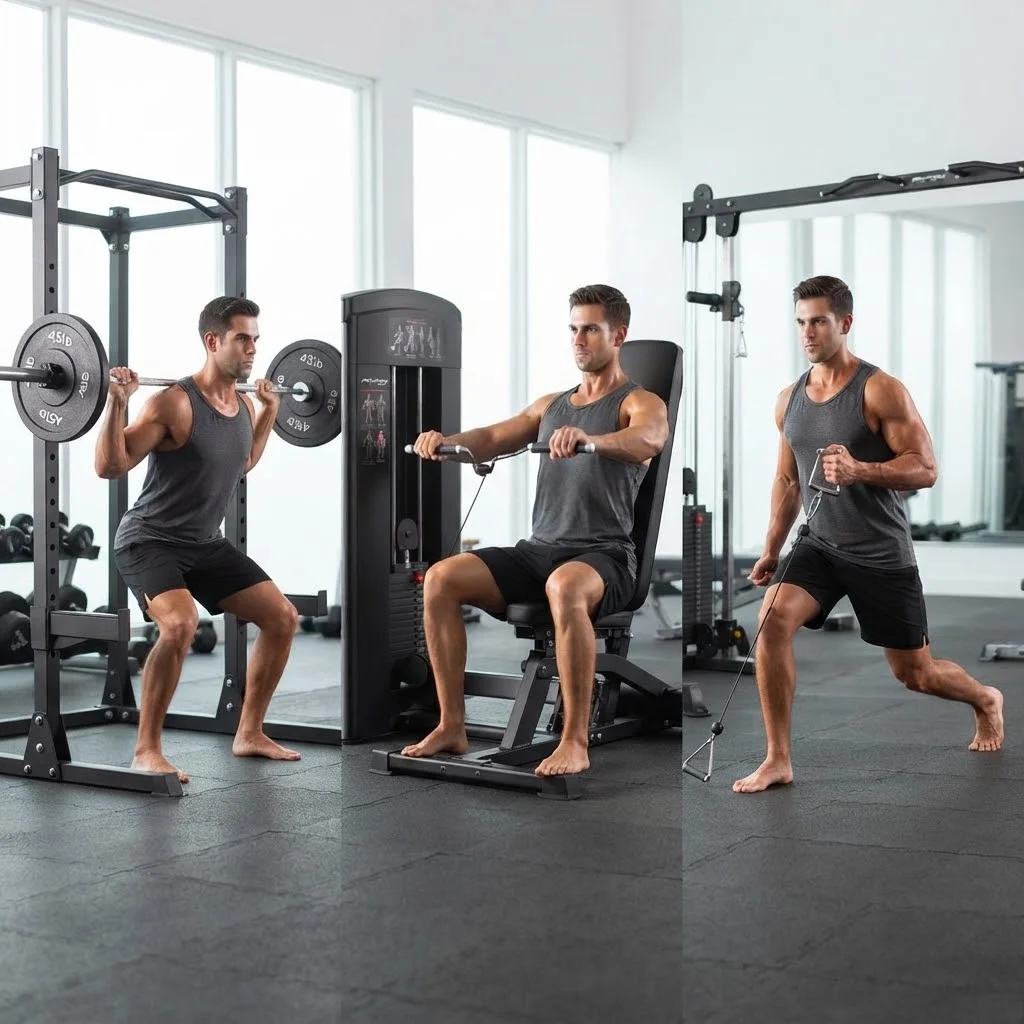
What Is a Full-Body Workout? becomes useful only when goals, weekly schedule, volume, and recovery capacity are considered together. A routine’s name or apparent difficulty does not determine results by itself.
The short answer
A full-body routine trains most major muscle groups in each session. It works especially well for beginners, people with limited time, and schedules of two or three weekly sessions, allowing movements to be practiced several times per week.
What matters most
Each session does not need several exercises per muscle. One leg movement, push, pull, hip hinge, and a few accessories may be enough.
Per-session muscle volume is lower but accumulates across the week, often preserving set quality.
If one workout is missed, most muscles were still trained in other sessions, which helps inconsistent schedules.
As experience and volume rise, sessions may become long. Rotate exercises across days or move to an upper/lower split when needed.
How to apply it
- Choose two or three nonconsecutive days
- Use 5–8 exercises per session
- Perform 2–4 sets per movement pattern
- Vary effort slightly across days
Common mistakes
- Copying a program designed for a different person
- Increasing load, sets, and training days all at once
- Sacrificing range and control for a bigger number
- Changing the plan before enough data are collected
Bottom line
A useful structure fits real life, can be logged, and remains sustainable for months. Start with a reasonable dose and adjust using performance, measurements, and recovery.
References
- Systematic review and meta-analysis — Split versus full-body training — https://pubmed.ncbi.nlm.nih.gov/38595233/
- Systematic review and meta-analysis — Training frequency and hypertrophy — https://pubmed.ncbi.nlm.nih.gov/30558493/