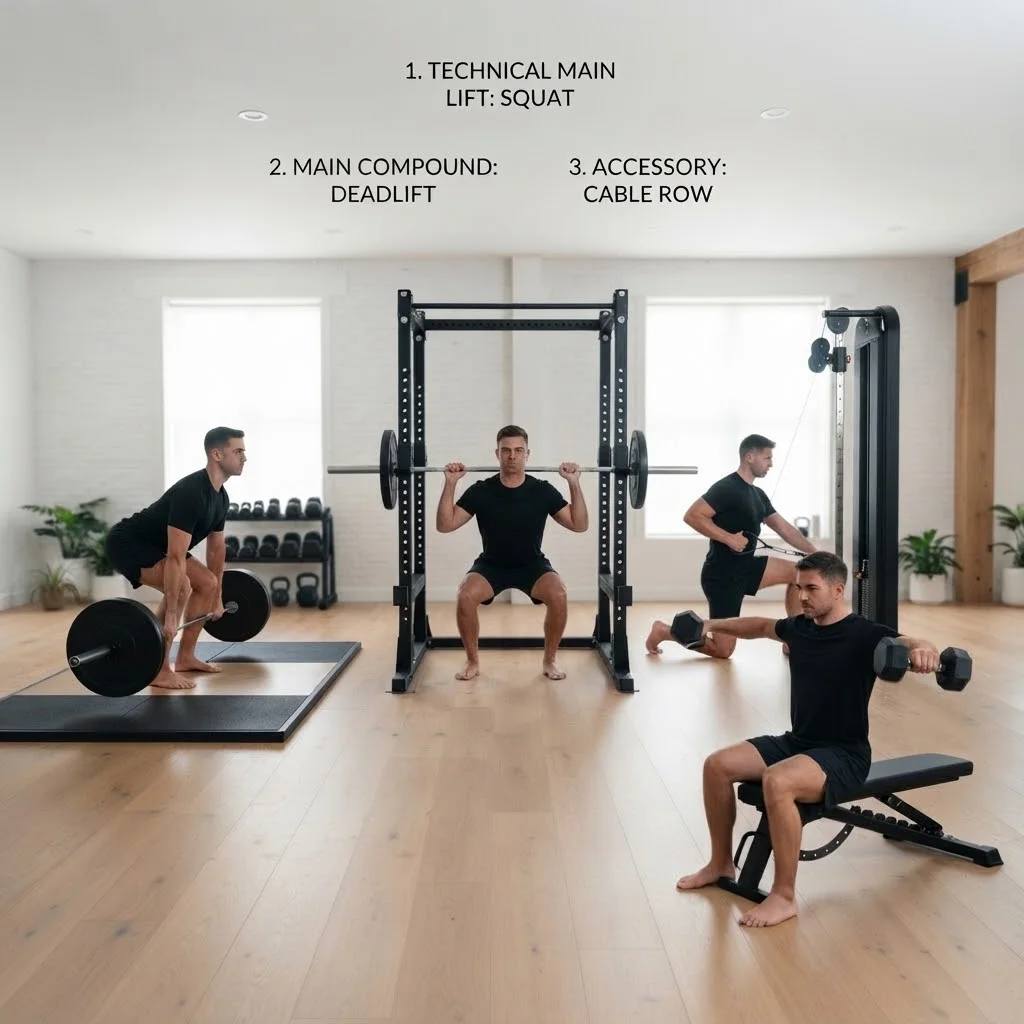
How Should Exercises Be Ordered in a Workout? depends on the goal, training experience, body structure, and execution quality. Instead of an absolute rule, choose an option that is pain-free, repeatable, and progressive.
The short answer
Place the exercise most important to your goal and requiring the most skill or focus earlier. Complex heavy movements often precede isolation work, but muscle priorities can justify a different order.
What matters most
Exercises performed first usually receive more load and repetitions. Choose the opening movement from actual priorities, not habit.
If squat strength is primary, squat early. If lateral delts are the priority, lateral raises can precede some pressing work.
Pre-fatiguing a muscle may increase sensation but can reduce performance on the main lift. Use it deliberately and measure the outcome.
Perform highly technical or higher-risk lifts while fresh. Machines and isolation exercises generally fit later.
How to apply it
- Define the session’s main objective
- Place the priority exercise first
- Perform remaining compound work
- Finish with safer accessories
Common mistakes
- Copying a program designed for a different person
- Increasing load, sets, and training days all at once
- Sacrificing range and control for a bigger number
- Changing the plan before enough data are collected
Bottom line
A good choice matches the goal and allows progress to be tracked. Keep standards consistent, collect several weeks of data, and then adjust from results.
References
- Umbrella review — Resistance training variables and hypertrophy — https://pmc.ncbi.nlm.nih.gov/articles/PMC9302196/
- ACSM — Progression models in resistance training — https://pubmed.ncbi.nlm.nih.gov/19204579/