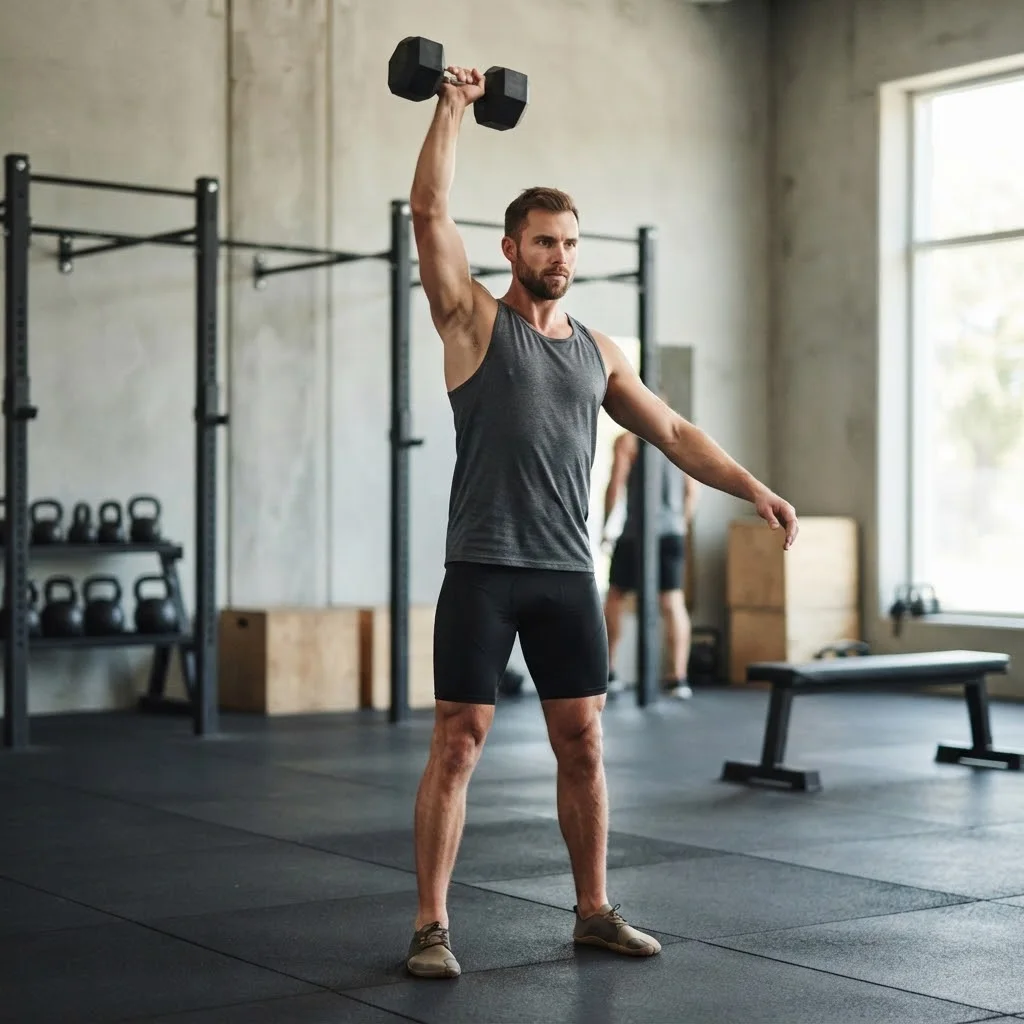
Daily movement and many sport skills are not perfectly symmetrical. Walking, running, and climbing stairs repeatedly place most of the load on one leg. Unilateral work trains that demand more directly, but it is not a reason to remove every bilateral lift.
The short answer
Unilateral training means performing an exercise with one arm or one leg at a time, such as a lunge, split squat, one-arm press, or one-arm row. Research does not show a clear, consistent hypertrophy advantage over bilateral training. Strength gains are specific, however: improving a single-limb task requires practicing it, while bilateral squat or press strength benefits from bilateral practice. Most programs work best with a combination.
Understanding the method
The main advantage is the ability to focus on each side. During bilateral work, the stronger side may compensate; in a single-limb exercise each side must produce its own effort. Small differences are normal, and the goal is not forced perfect symmetry.
Unilateral exercises can create a strong local stimulus with less external load. This helps at home, when reducing total spinal loading, or when adding volume without a heavy barbell. Balance demands can also limit the target muscle before it is fully challenged.
When addressing a side-to-side difference, begin with the weaker side and do not exceed its repetitions on the stronger side. Match load and range, but have pain or a meaningful mobility restriction assessed rather than assuming it is simply weakness.
Single-limb work takes longer because both sides need a set. Not every exercise must be unilateral. One or two assistance movements are often enough while bilateral main lifts preserve time efficiency.
A large asymmetry, sudden strength loss, numbness, or one-sided pain is not solved by adding more sets. Professional assessment is more appropriate than self-directed compensation in those situations.
| Goal | Useful choice | Example |
|---|---|---|
| Bilateral strength | Prioritize bilateral work | Barbell squat |
| Single-limb strength | Prioritize unilateral work | Split squat |
| Hypertrophy | Either can work | Two- or one-arm dumbbell press |
| Side-to-side balance | Start with weaker side | One-arm row |
Practical guide
- Keep one bilateral main lift.
- Add one relevant unilateral movement.
- Begin with the weaker side.
- Match repetitions and range on both sides.
- Track each side separately.
Common mistakes
- Removing all bilateral lifts
- Adding load at the cost of balance
- Giving extra repetitions to the stronger side
- Treating every small difference as an injury
Frequently asked questions
Does unilateral training build more muscle?
Not generally. With challenging sets, useful range, and similar volume, both approaches can build muscle.
How much side-to-side difference is normal?
There is no universal cutoff. A stable pattern matters more than one test; a sudden or painful difference deserves assessment.
Bottom line
Unilateral training is a valuable complementary tool, not a mandatory replacement for every lift. Use it for a defined purpose and match the unilateral-bilateral mix to the actual goal.
References
- Systematic review and meta-analysis — Unilateral versus bilateral resistance training — https://pubmed.ncbi.nlm.nih.gov/39794667/
- Systematic review — Unilateral versus bilateral training and physical performance — https://pubmed.ncbi.nlm.nih.gov/35959319/
- ACSM Position Stand — Resistance Training Prescription for Healthy Adults — https://pubmed.ncbi.nlm.nih.gov/41843416/