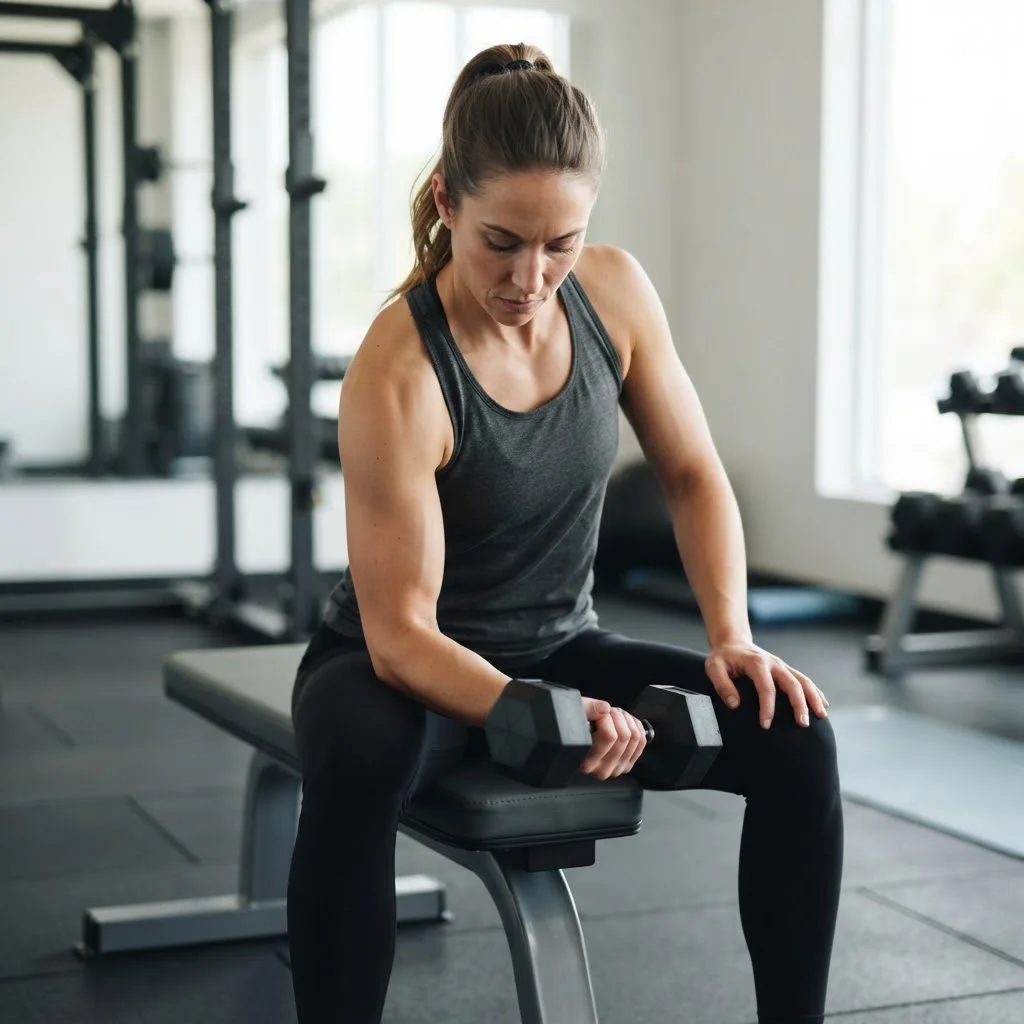
During a curl, lifting the dumbbell is concentric and lowering it under control is eccentric. The muscle produces force while lengthening. This capacity allows substantial loads to be controlled, but a sudden large eccentric dose can cause considerable soreness.
The short answer
Eccentric training emphasizes muscle lengthening under load, such as descending in a squat, lowering the bar in a press, or extending the elbow during a curl. The simplest application is a controlled two-to-four-second lowering phase with normal training loads. Eccentric overload using more than you can lift concentrically is advanced and requires equipment, spotters, or coaching. It can develop strength and muscle, but current evidence does not show universal superiority over full-repetition training.
Understanding the method
The eccentric phase is already part of most resistance exercises, so a separate program is not always necessary. Simply avoiding uncontrolled dropping and keeping the path deliberate improves ordinary training quality.
Muscles generally produce more force eccentrically than concentrically. You may be able to lower a load that you cannot lift, but this capacity does not automatically make supramaximal eccentric work appropriate for routine training.
A novel eccentric dose, especially at long muscle lengths, can create greater DOMS. Begin with one or two sets at a moderate lowering speed and observe the response over the following 48–72 hours before adding load.
Eccentric protocols are used in tendon and muscle rehabilitation, but therapeutic loading must match diagnosis and tissue tolerance. Sharp pain, swelling, sudden weakness, or progressive worsening are reasons to stop self-directed progression and seek assessment.
For hypertrophy, a controlled lowering phase, useful range, and appropriate effort are usually enough. Extending every descent to eight or ten seconds is rarely necessary and may reduce productive volume.
| Level | Method | Useful for | Caution |
|---|---|---|---|
| Basic | 2–3-second lowering | Most lifters | Appropriate load |
| Emphasized | 3–5 seconds with controlled pause | Skill and variety | Limited volume |
| Eccentric-only | Assisted lift, controlled lowering | Experienced lifters | Needs spotter or equipment |
| Rehabilitation | Tissue-specific protocol | Clinically assessed cases | Avoid self-treatment |
Practical guide
- Choose a familiar exercise with a safe movement path.
- Begin with roughly 10–20% less load than your normal set if the descent is much slower.
- Control the lowering phase for two to four seconds.
- Perform the lifting phase naturally without unnecessary assistance.
- Start with low volume and record soreness, performance, and recovery over the next two days.
Common mistakes
- Starting suddenly with a high eccentric volume
- Using supramaximal loads without spotters or equipment
- Losing position merely to prolong the lowering time
- Continuing rehabilitation loading through sharp or worsening pain
Frequently asked questions
Must the negative phase always be slow?
No. It should be controlled, but exact speed follows the goal. Two to three seconds is sufficient for many sets, while power training may use a faster rhythm.
Does more next-day soreness mean a better eccentric stimulus?
No. Greater soreness is common when the method is new, but it is not a growth score. The dose should allow range and strength to recover in time for subsequent training.
Bottom line
Eccentric training is a useful way to improve control and vary loading, but it does not need to be complicated or supramaximal. For most people, a controlled descent, appropriate range, and gradual progression are enough.
References
- Systematic review and meta-analysis — Eccentric versus concentric actions and hypertrophy — https://pubmed.ncbi.nlm.nih.gov/39652733/
- Systematic review — Duration of the eccentric phase and training adaptations — https://pubmed.ncbi.nlm.nih.gov/40692176/
- Systematic review and meta-analysis — Advanced resistance-training systems — https://pubmed.ncbi.nlm.nih.gov/41718208/