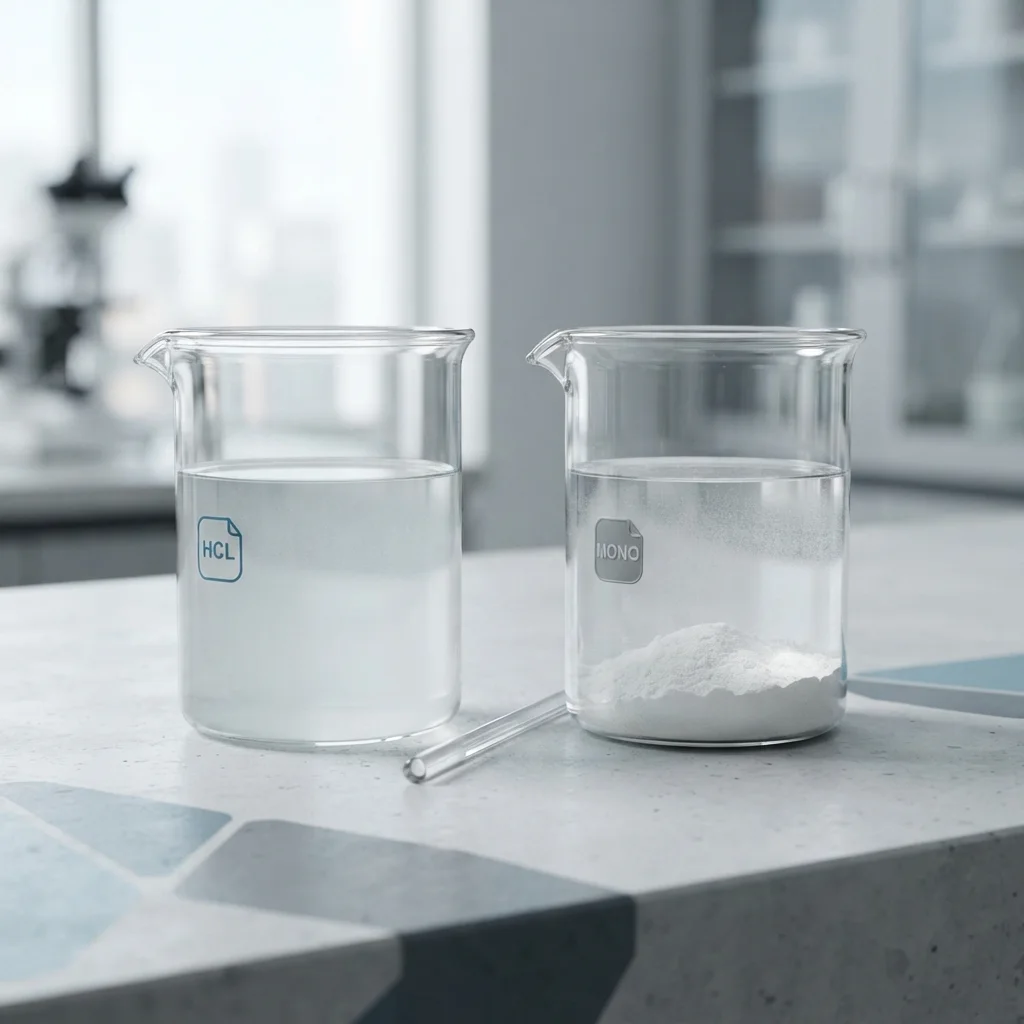
Creatine hydrochloride is a salt designed to dissolve more readily in water. That chemical property is real, but marketing often jumps from “dissolves better” to “absorbs better and works at a much smaller dose.” Those claims are not equivalent.
Quick answer
HCL is a usable creatine form, but direct long-term human evidence is much smaller than for monohydrate. Convincing evidence that typical HCL use produces greater strength or muscle is lacking. Monohydrate remains the first choice for evidence and value; HCL is an alternative, not a proven upgrade.
What matters
- Solubility, stability, absorption, and final outcomes are separate concepts. Improving one does not automatically improve the others.
- Claims for a much smaller dose require evidence of muscle creatine elevation and performance benefit, not merely label instructions.
- For gastrointestinal discomfort from a large monohydrate dose, first try skipping loading, dividing doses, or using a smaller daily amount.
- Compare the cost of the actual creatine amount over time, not capsule count or scoop size.
- HCL still needs transparent labeling and third-party testing; a different form does not solve manufacturing quality.
A practical approach
- Define outcome and tolerance goals.
- Use monohydrate as the benchmark.
- Calculate actual dose and cost.
- Demand direct evidence for superiority.
- If chosen, track results consistently.
Frequently asked questions
Does HCL cause less stomach upset?
Some people report better tolerance, but a definitive advantage has not been established in strong comparative research.
Does 1 g HCL equal 5 g monohydrate?
No strong evidence establishes such a fixed conversion; do not trust a numerical claim without direct data.
References
- Creatine and Creatine Forms Intended for Sports Nutrition — https://pubmed.ncbi.nlm.nih.gov/28019093/
- ISSN Position Stand: Safety and Efficacy of Creatine Supplementation — https://pubmed.ncbi.nlm.nih.gov/28615996/
- Common Questions and Misconceptions About Creatine Supplementation — https://pubmed.ncbi.nlm.nih.gov/33557850/