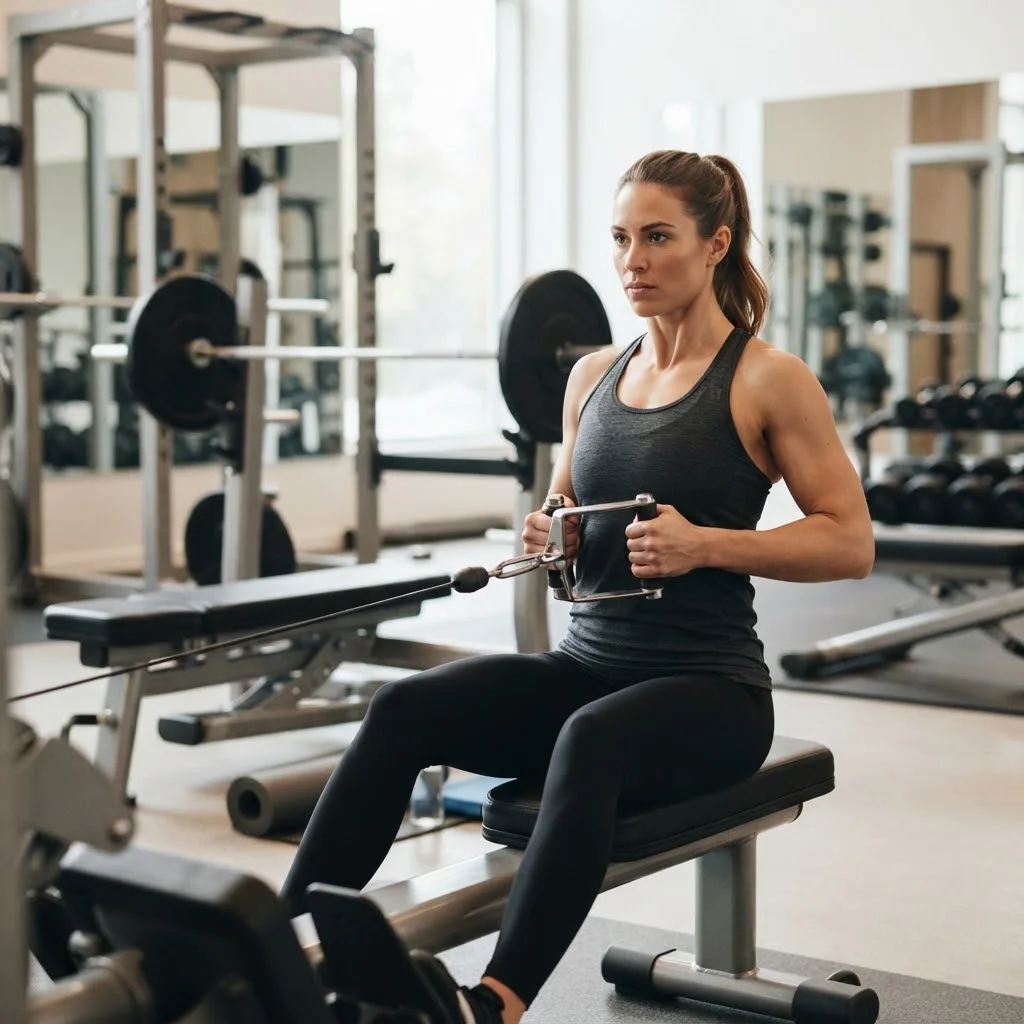
When time is limited, removing rest seems attractive. Supersets can make training more efficient, but a poor exercise pairing may reduce repetitions and technique enough to lower overall workout quality.
The short answer
A superset performs one set of two different exercises back-to-back before resting. For time efficiency, pairing opposing muscles such as biceps and triceps, or distant regions such as upper and lower body, is often better than pairing two demanding exercises for the same muscle. Current evidence suggests similar long-term strength and hypertrophy can be achieved in less time, although acute effort and fatigue are higher.
Understanding the method
Agonist-antagonist pairings often preserve performance better because the first muscle receives relative rest during the second exercise. Bench press with a row, or biceps with triceps, are common examples.
Same-muscle supersets, such as a press followed by a fly, create more local fatigue and burning. They can be used with lower-risk exercises near the end of a workout, but load or repetitions on the second movement usually decline.
Pairing two heavy compound lifts such as squats and deadlifts is a poor choice for most people. Breathing, grip, and trunk stability become limiting, and the time saved may be offset by lower quality.
A superset does not eliminate rest; it relocates it. After both exercises, roughly 90–180 seconds may be needed, with shorter intervals sometimes sufficient for lighter work.
If maximal strength in one lift is the priority, perform that exercise traditionally with full rest. Reserve supersets for assistance work, the later part of the session, or genuinely time-limited days.
| Superset type | Example | Advantage | Caution |
|---|---|---|---|
| Opposing muscles | Bench press + row | Better performance preservation | Equipment logistics |
| Upper and lower body | Shoulder press + leg curl | Time efficiency | Higher cardiovascular demand |
| Same muscle | Chest press + fly | High local stimulus | Second-exercise drop-off |
| Main lift + trunk | Machine press + plank | Uses rest time | Must not impair main-lift stability |
Practical guide
- Define the purpose: saving time or increasing local fatigue.
- Choose exercises with practical equipment access and limited fatigue interference.
- Do not take the first movement to failure if that ruins the second.
- Rest adequately after each pair and record repetitions.
- If volume or technique clearly declines, change the pairing or rest interval.
Common mistakes
- Supersetting every exercise from the start
- Occupying several stations in a crowded gym
- Pairing two heavy lifts with high stability demands
- Reducing rest until cardiovascular strain replaces the muscular target
Frequently asked questions
Does a superset build more muscle?
Not necessarily. With comparable volume and effort, long-term results may be similar to traditional sets. Its main advantage is time efficiency, not a unique magical growth effect.
Is it suitable for beginners?
After learning exercise technique, beginners can use simple, low-risk pairings. Fast transitions should not replace skill practice or adequate recovery.
Bottom line
Supersets are useful when they save time without sacrificing technique or effective volume. Start with opposing or distant muscle groups and keep heavy priority lifts on full-rest traditional sets.
References
- Systematic review and meta-analysis — Supersets versus traditional sets — https://pubmed.ncbi.nlm.nih.gov/39903375/
- ACSM Position Stand — Resistance Training Prescription for Healthy Adults — https://pubmed.ncbi.nlm.nih.gov/41843416/