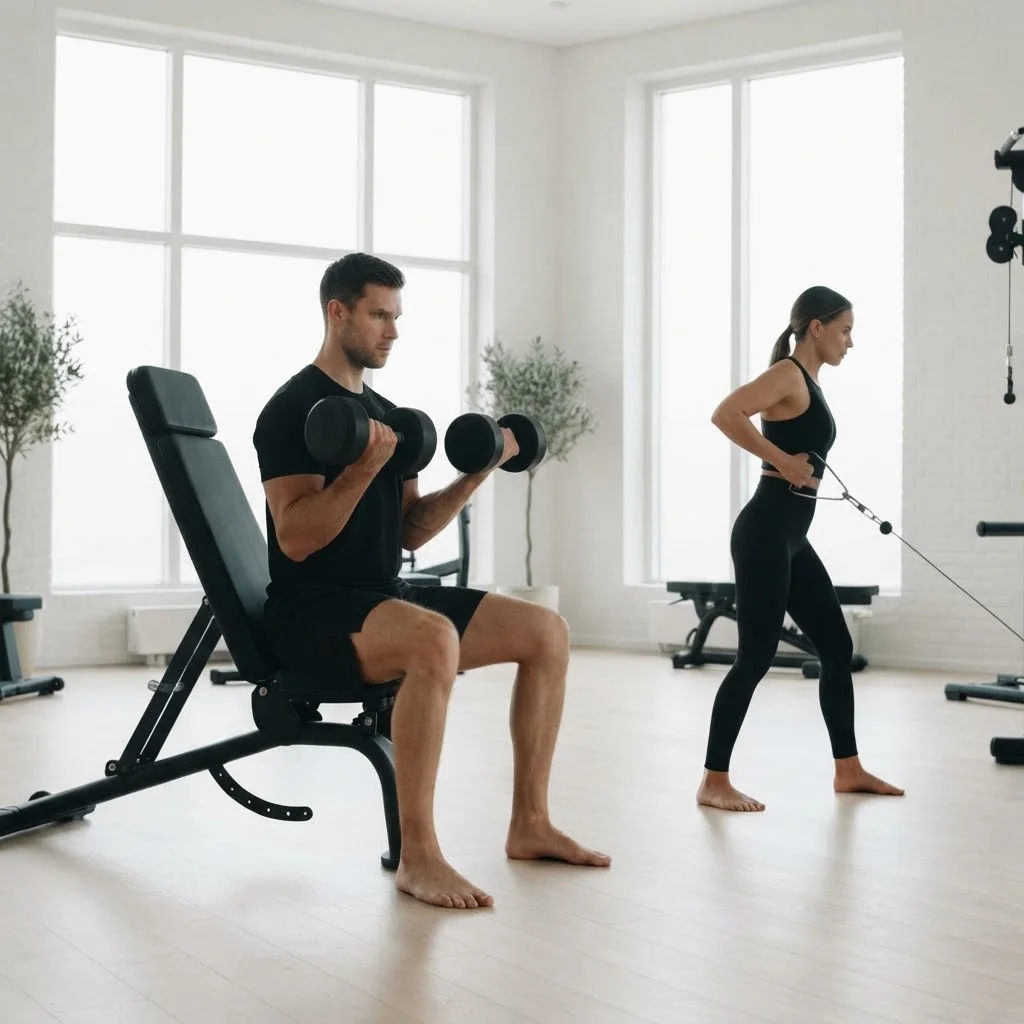
Are Free Weights or Machines Better? depends on the goal, training experience, body structure, and execution quality. Instead of an absolute rule, choose an option that is pain-free, repeatable, and progressive.
The short answer
Both free weights and machines can build muscle effectively. The better choice depends on goals, experience, safety, access, and joint comfort. Strength is partly specific, so you improve most with the tool you practice.
What matters most
Meta-analyses find no meaningful hypertrophy difference between modalities, so machines are not ineffective and free weights are not universally superior.
Free weights demand more balance and coordination and are necessary for skills such as barbell squats or presses. Machines provide a stable path and easier local focus.
Machines are often safer for near-failure training without a spotter and may simplify learning how to load a target muscle.
Avoid ideological choices. Select pain-free, progressive movements that match the goal; many programs benefit from both.
How to apply it
- Define goals and constraints
- Practice the tool required for a specific skill
- For hypertrophy, use the comfortable progressive option
- Combine both when useful
Common mistakes
- Copying a program designed for a different person
- Increasing load, sets, and training days all at once
- Sacrificing range and control for a bigger number
- Changing the plan before enough data are collected
Bottom line
A good choice matches the goal and allows progress to be tracked. Keep standards consistent, collect several weeks of data, and then adjust from results.
References
- Systematic review and meta-analysis — Free weights versus machines — https://pubmed.ncbi.nlm.nih.gov/37582807/
- Umbrella review — Resistance training variables and hypertrophy — https://pmc.ncbi.nlm.nih.gov/articles/PMC9302196/