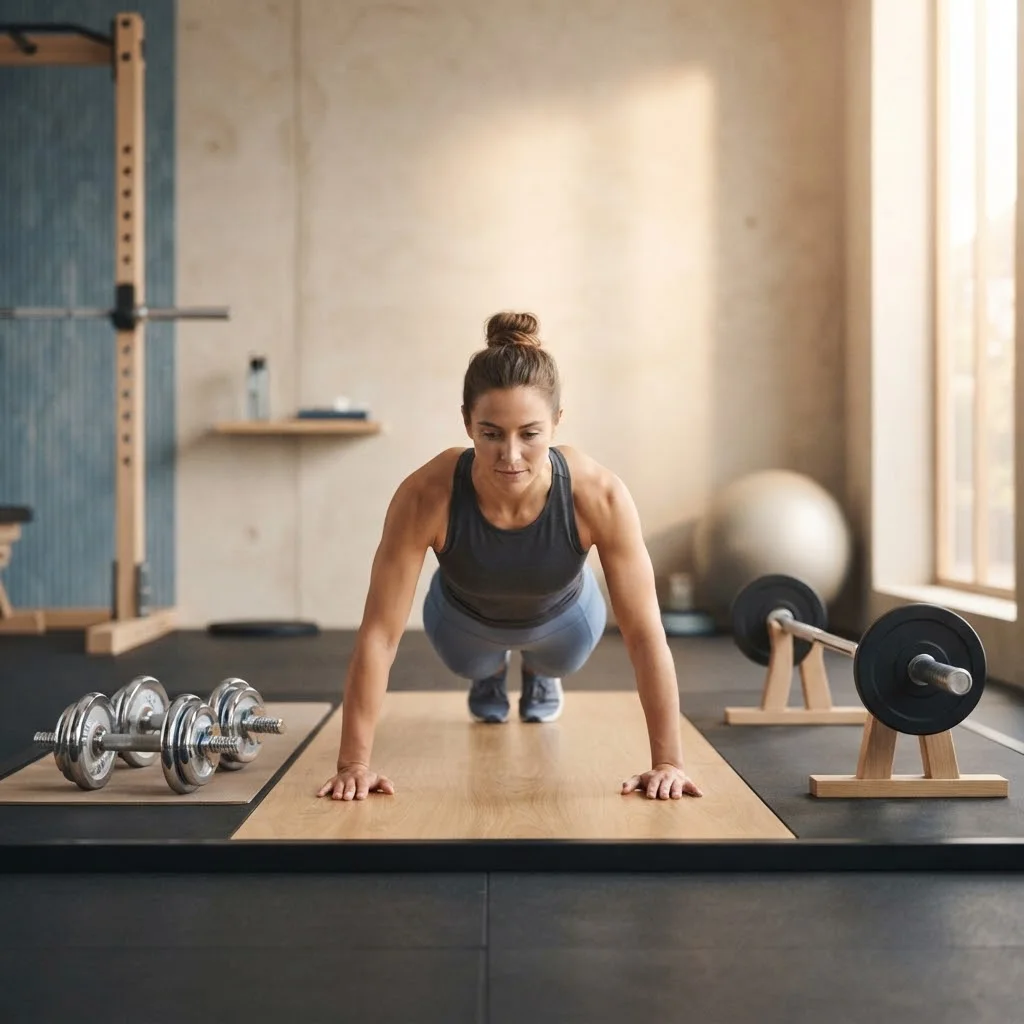
Push-ups, pull-ups, and bodyweight squats are real resistance training, not inferior substitutes for a gym. The limitation appears when an exercise becomes too easy to progress precisely or so difficult that skill fails before the target muscle. External weights make adjustment easier, but they are not always required.
The short answer
Neither is universally better. A bodyweight movement can build strength and muscle when it produces a challenging set with sound technique and can be progressed over time. Comparative research shows that load-matched push-ups can produce adaptations similar to a light bench press. Weights are usually easier for small load adjustments, strong-leg training, and precise tracking; bodyweight work excels in access, low cost, and consistency.
Understanding the method
Progressive overload is the shared principle. With weights, you may add two kilograms. With bodyweight work, increase repetitions, range, pauses, leverage difficulty, foot elevation, or external loading. Simply chasing extremely high repetitions is not always practical.
For the upper body, push-ups, dips, pull-ups, and inverted rows offer long progression paths. For the lower body, a standard squat becomes easy relatively soon; single-leg versions, controlled tempo, or external load may become necessary.
Strength is specific. Someone who only performs push-ups can become excellent at push-ups, but improving a bench-press maximum requires bench-press practice. Similar muscles do not guarantee complete transfer of skill and strength.
Bodyweight training may be more sustainable because it removes travel and facility barriers. A simple plan completed three times each week outperforms a more complete plan that is repeatedly skipped.
Combining methods is often easiest: weighted main lifts for precise adjustment and bodyweight accessories for volume, skill, or sessions away from the gym. Choose based on actual constraints rather than loyalty to a training identity.
| Criterion | Bodyweight | Weights |
|---|---|---|
| Access | Very easy | Requires equipment |
| Load adjustment | Exercise variations | Precise increments |
| Leg training | Harder to progress later | Broad options |
| Tracking | Must record variation | Load and reps are clear |
Practical guide
- Define the primary goal.
- Choose a progressable exercise for each movement pattern.
- Use a repetition range that creates a genuinely challenging set.
- When the top of the range becomes easy, increase difficulty.
- Review progress quality every six to eight weeks.
Common mistakes
- Very high repetitions without meaningful effort
- Choosing flashy skills over controllable progressions
- Ignoring pulling work in home programs
- Assuming more sweat means more hypertrophy
Frequently asked questions
Can bodyweight training alone build a muscular body?
Yes, especially for beginners and intermediates, but exercises and loading must progress as you become stronger.
Which is better for a beginner?
The option that is safe, available, and progressable. A mix of bodyweight movements with dumbbells or bands is simple for many beginners.
Bottom line
The body does not respond to the labels barbell or bodyweight; it responds to tension, effort, range, and progression. Choose the method that lets you apply those factors consistently and measurably.
References
- Randomized trial — Low-load bench press versus load-matched push-up training — https://pubmed.ncbi.nlm.nih.gov/29541130/
- Training study — Free-weight versus body-mass resistance training — https://pubmed.ncbi.nlm.nih.gov/37133323/
- ACSM Position Stand — Resistance Training Prescription for Healthy Adults — https://pubmed.ncbi.nlm.nih.gov/41843416/