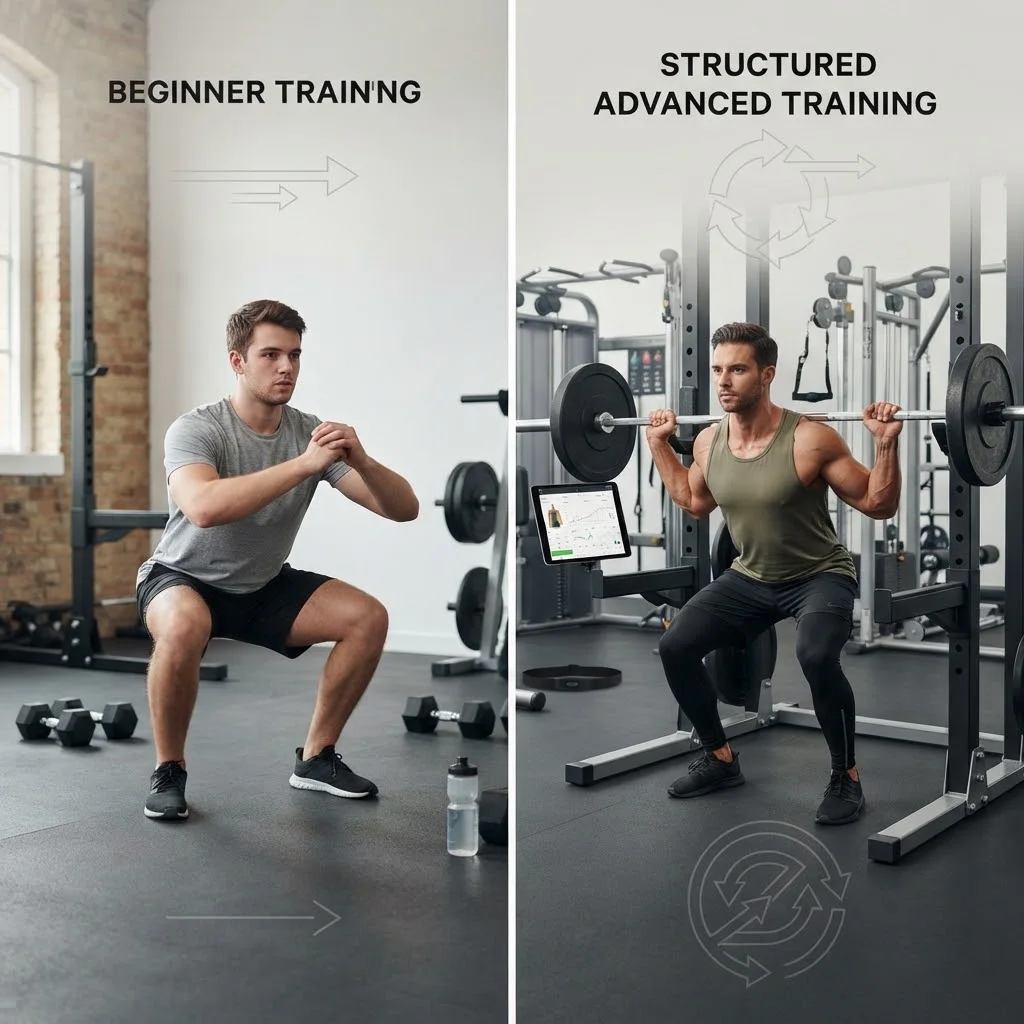
How Do Beginner and Advanced Training Programs Differ? becomes useful only when goals, weekly schedule, volume, and recovery capacity are considered together. A routine’s name or apparent difficulty does not determine results by itself.
The short answer
Beginner programs are simpler, use fewer movements, and progress faster. Experienced lifters need more specific volume, fatigue management, and planning to create smaller improvements. Advanced does not mean unnecessarily complicated.
What matters most
Beginners may add repetitions or load nearly every session because skill and neural adaptation improve quickly. Experienced lifters may need weeks for measurable progress.
Beginners grow with less volume; adding sets too early mainly creates soreness and fatigue. Experienced lifters may need more volume for selected muscles.
Advanced programs may use periodization, deloads, and specialization, but each tool should solve a real problem.
Sleep, nutrition, and stress matter at every level, but higher volume and intensity leave experienced athletes less room for poor recovery.
How to apply it
- Assess training level honestly
- Start with the minimum effective workload
- Match progression speed to experience
- Add complexity only when needed
Common mistakes
- Copying a program designed for a different person
- Increasing load, sets, and training days all at once
- Sacrificing range and control for a bigger number
- Changing the plan before enough data are collected
Bottom line
A useful structure fits real life, can be logged, and remains sustainable for months. Start with a reasonable dose and adjust using performance, measurements, and recovery.
References
- BJSM network meta-analysis — Resistance training prescription — https://pubmed.ncbi.nlm.nih.gov/37414459/
- Systematic review and meta-analysis — Weekly volume and hypertrophy — https://pubmed.ncbi.nlm.nih.gov/27433992/