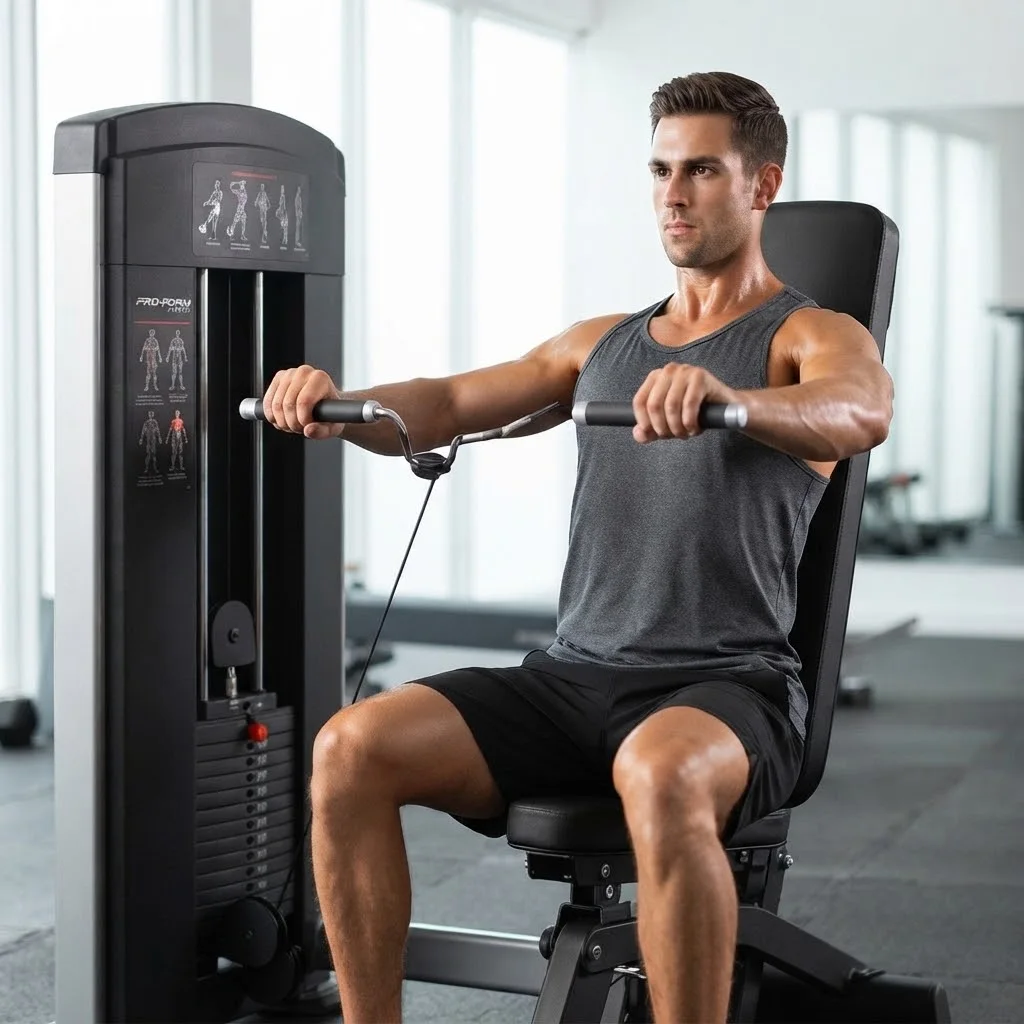
Are Gym Machines Effective for Muscle Growth? depends on the goal, training experience, body structure, and execution quality. Instead of an absolute rule, choose an option that is pain-free, repeatable, and progressive.
The short answer
Yes. Machines can provide sufficient tension, controlled range, and progressive overload, making them fully effective for hypertrophy. Machine design and how it fits your body matter more than the label itself.
What matters most
A fixed path reduces balance demands and lets effort focus on the target muscle, especially during sets close to failure.
Not every machine fits every body. Adjust the seat, handles, and joint alignment; choose another machine if the path feels painful.
Machines suit beginners, older adults, return-to-training phases, or athletes adding volume, but they do not automatically build free-weight skill.
Track machine training like free weights: seat position, range, load, repetitions, and RIR must remain comparable.
How to apply it
- Choose a machine that fits your body
- Adjust the seat and joint axis
- Standardize a pain-free range
- Progress load or repetitions gradually
Common mistakes
- Copying a program designed for a different person
- Increasing load, sets, and training days all at once
- Sacrificing range and control for a bigger number
- Changing the plan before enough data are collected
Bottom line
A good choice matches the goal and allows progress to be tracked. Keep standards consistent, collect several weeks of data, and then adjust from results.
References
- Systematic review and meta-analysis — Free weights versus machines — https://pubmed.ncbi.nlm.nih.gov/37582807/
- Umbrella review — Resistance training variables and hypertrophy — https://pmc.ncbi.nlm.nih.gov/articles/PMC9302196/